Projects
Our North Sea Vision
The SwitcH2 vision is to utilise a central location in the North Sea to produce green hydrogen. This will be done by connecting the H2 FPSO to a bottom fixed wind park, utilizing the offshore wind energy as the primary source of power for the onboard. Once the hydrogen is produced, the FPSO will be connected to the existing gas infrastructure, allowing the hydrogen to be brought onshore efficiently and at low cost. The use of the existing gas infrastructure and the planned dedicated hydrogen infrastructure, out green hydrogen can be delivered to off-takers in the Benelux, the UK and Germany.
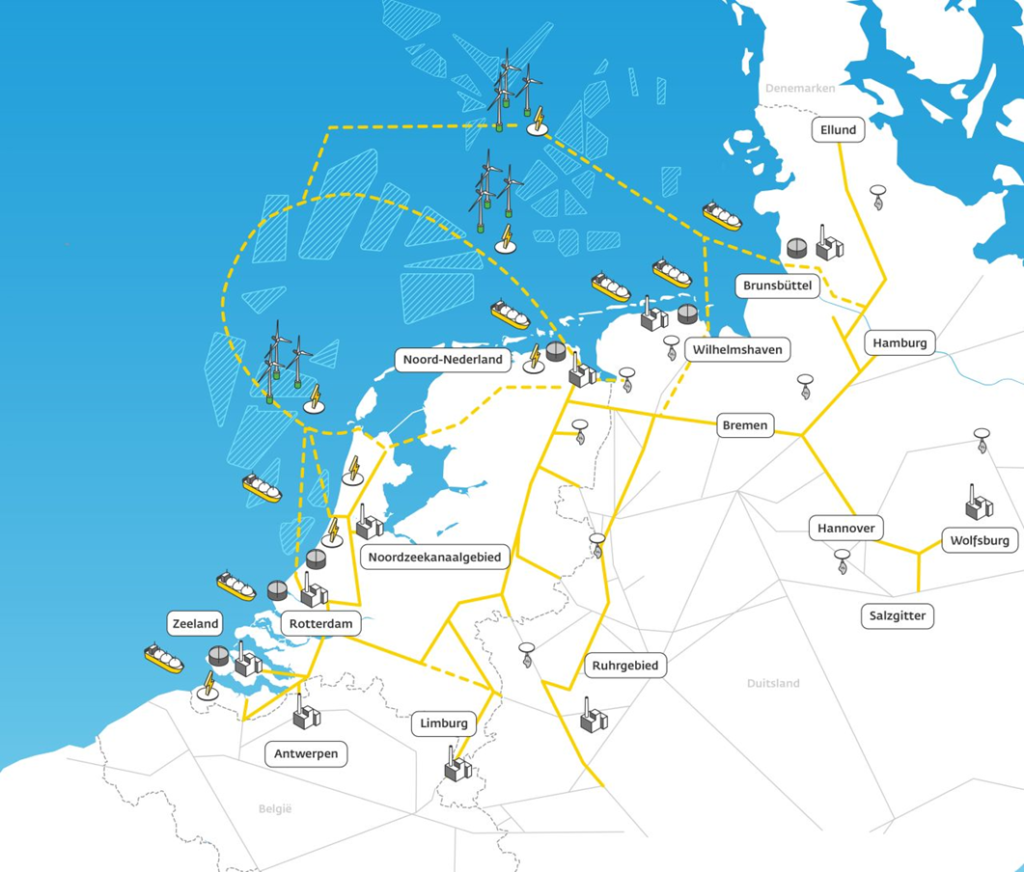
Our Worldwide Vision
2. Consortium Formation and Financial Structuring
Q1 - Q4 2024
Having successfully concluded the Proof of Concept, SwitcH2 has proceeded to the next phase. Power Purchase Agreements (PPAs) and Offtake Agreements are currently being negotiated and next year the Asset Owning Consortium comprising industry players will be formed. The funding for the Engineering, Procurement, Construction, and Installation (EPCI) scope, the Operations contract and the Project Management contract will be secured through a Special Purpose Vehicle (SPV). With a fully ESG compliant proposition, we know we can count on the support of numerous large equity and debt providers.
1. Engineering Foundations
Present - Mid 2024
The green hydrogen and ammonia FPSO project embarks on a structured journey mirroring typical large-scale industrial initiatives. Initiated by SwitcH2, this phase focuses on concept, basic, and detailed engineering processes. An agreed Basis of Design serves as the blueprint, meticulously detailing design parameters for the H2/NH3 FPSO. As of July 2022, DNV has granted Approval in Principle, validating the project’s technical credibility. This engineering groundwork is anticipated to be concluded by mid-2024.
3. Implementation and Delivery
2025 - 2028
Entering the final phase, the SPV will have commissioned the Engineering, Procurement, Construction, and Installation (EPCI) scope, the Project Management scope the Operations contract,. The Project Management services will also include Interface management, to ensure a delivery on time and on budget. The Operations Contract is aimed at the safe and reliable production, handling and offloading of green hydrogen / green ammonia on board the FPSO. The ultimate objective is to sell green hydrogen / green ammonia to offtakers with first cargoes to be lifted Q1 2029.
FPSO vs Onshore
- No investment needed in cables from the windfarm to substations and electrical conductivity to shore.
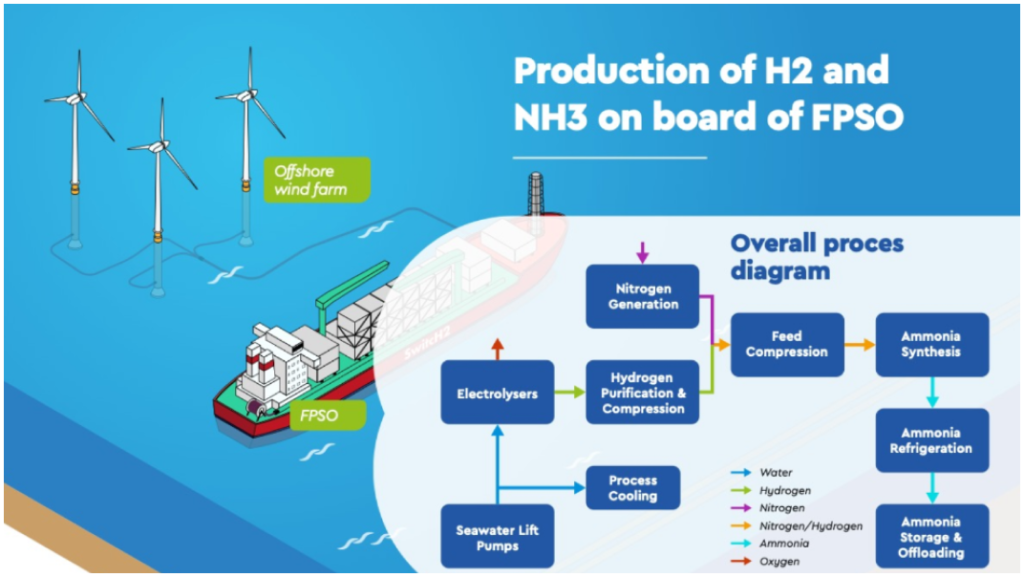
- The power can be taken directly from the wind turbines as the conversion and transformation takes place on the FPSO
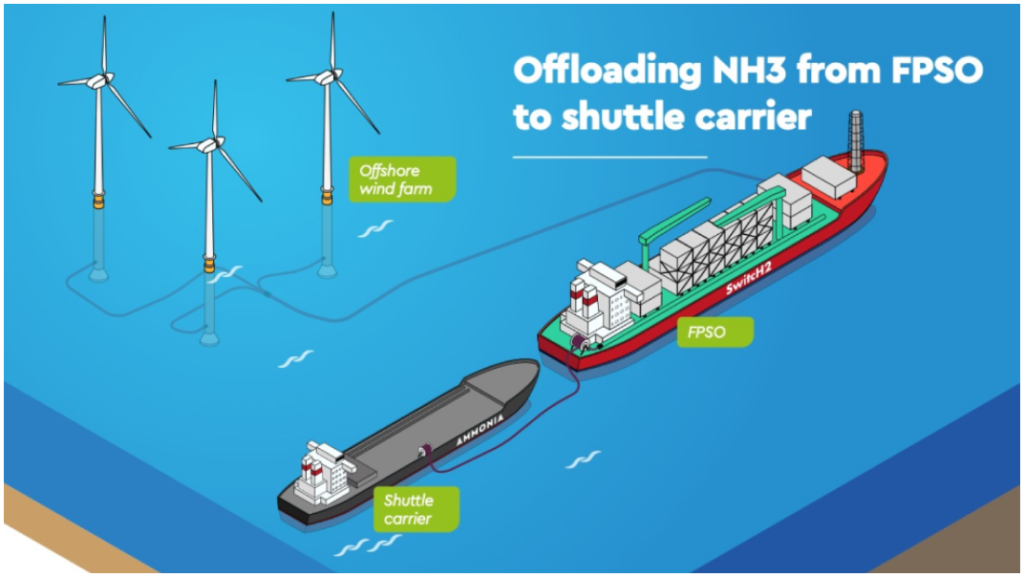
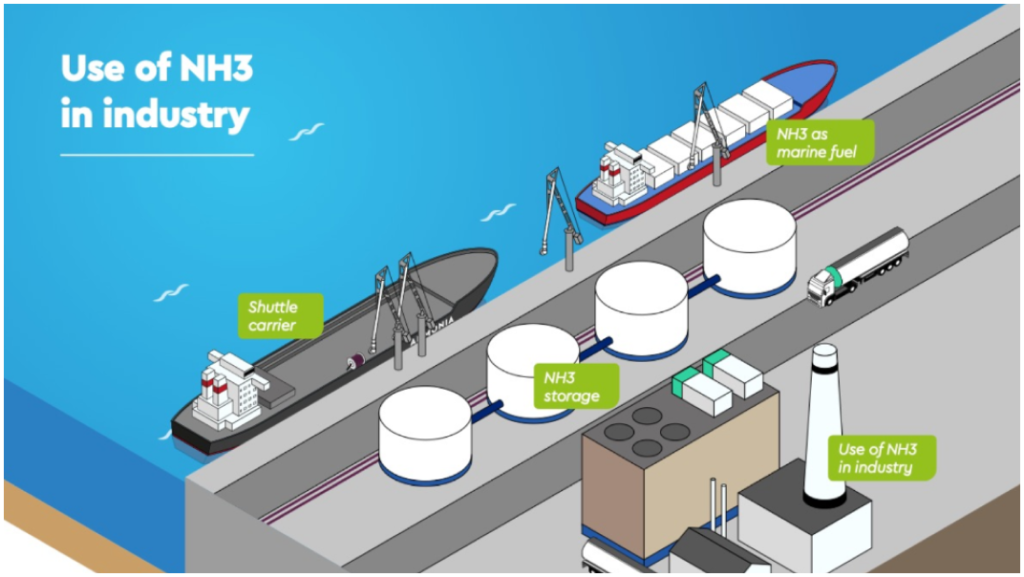
- Hydrogen can be easily transformed offshore into ammonia, stored inside the hull and offloaded via shuttle tankers
- Offshore permitting is quicker and easier: a floater can be in production faster than an onshore electrolyser facility as there is no cumbersome land permitting involved
- For safety and environmental reasons, it is preferred to produce hydrogen/ammonia offshore than on land or in busy industrial areas
- The FPSO offers flexibility of deployment: although permanently moored, the entire system can be sailed to a different site and produce there
FPSO vs Fixed Platform
- An FPSO has a minimal impact on the seabed in comparison with a fixed platform as only the mooring system is anchored.
- Fixed platforms and topsides have to be installed by specialized big crane vessels
- A fixed platform needs to be much bigger than an FPSO to host the same electrolyzer system
- Fixed platforms do not have storage space, hence cannot convert hydrogen to ammonia for easier transport to shore